Eliise Soolepp The invisble labour of a pole dancer
Eliise Soolepp The invisble labour of a pole dancer
text by Baron Skain
photography by Olof Ekman
text by Baron Skain
photography by Olof Ekman

We first met in an unassuming venue beneath the railway arches, a space shaped by constant motion. Trains rumbled overhead at regular intervals while we talked about creative projects, $uicideboy$, and backpacking across Europe — two high plain drifters crossing paths in Berlin. At the time, I understood only fragments of Eliise Soolepp’s life. Later, I would learn that, like the trains overhead, her movement functions on an architecture that is largely taken for granted. What appears easy and fluid is sustained by her passion, discipline, and years of experience. The motion is visible, the work that makes it possible rarely is. Originally from Estonia, Eliise is tall, tattooed, and carefully assembled: fang-tipped grills, manicured nails, posture deliberate. Self-managed, attentive, and highly driven. Eliise’s working life resists easy categorisation. Under moon and sun, she moves between performance artist, pole dancer, stripper, domina, model, actor, teacher, and software developer — often simultaneously and autonomously. In a lofty Spandau apartment surrounded by snakes and cats, our discussion frames the sex industry not as a singular field, but as a spectrum of labour, art, and identity — operating under different expectations and risks. Working within an industry still shaped by stigma and moral judgement, Eliise describes how her work is frequently dismissed as illegitimate by those far removed from its conditions. What appears on stage as sensual ease gives little indication of the structures that sustain it.
We first met in an unassuming venue beneath the railway arches, a space shaped by constant motion. Trains rumbled overhead at regular intervals while we talked about creative projects, $uicideboy$, and backpacking across Europe — two high plain drifters crossing paths in Berlin. At the time, I understood only fragments of Eliise Soolepp’s life. Later, I would learn that, like the trains overhead, her movement functions on an architecture that is largely taken for granted. What appears easy and fluid is sustained by her passion, discipline, and years of experience. The motion is visible, the work that makes it possible rarely is. Originally from Estonia, Eliise is tall, tattooed, and carefully assembled: fang-tipped grills, manicured nails, posture deliberate. Self-managed, attentive, and highly driven. Eliise’s working life resists easy categorisation. Under moon and sun, she moves between performance artist, pole dancer, stripper, domina, model, actor, teacher, and software developer — often simultaneously and autonomously. In a lofty Spandau apartment surrounded by snakes and cats, our discussion frames the sex industry not as a singular field, but as a spectrum of labour, art, and identity — operating under different expectations and risks. Working within an industry still shaped by stigma and moral judgement, Eliise describes how her work is frequently dismissed as illegitimate by those far removed from its conditions. What appears on stage as sensual ease gives little indication of the structures that sustain it.
We first met in an unassuming venue beneath the railway arches, a space shaped by constant motion. Trains rumbled overhead at regular intervals while we talked about creative projects, $uicideboy$, and backpacking across Europe — two high plain drifters crossing paths in Berlin. At the time, I understood only fragments of Eliise Soolepp’s life. Later, I would learn that, like the trains overhead, her movement functions on an architecture that is largely taken for granted. What appears easy and fluid is sustained by her passion, discipline, and years of experience. The motion is visible, the work that makes it possible rarely is. Originally from Estonia, Eliise is tall, tattooed, and carefully assembled: fang-tipped grills, manicured nails, posture deliberate. Self-managed, attentive, and highly driven. Eliise’s working life resists easy categorisation. Under moon and sun, she moves between performance artist, pole dancer, stripper, domina, model, actor, teacher, and software developer — often simultaneously and autonomously. In a lofty Spandau apartment surrounded by snakes and cats, our discussion frames the sex industry not as a singular field, but as a spectrum of labour, art, and identity — operating under different expectations and risks. Working within an industry still shaped by stigma and moral judgement, Eliise describes how her work is frequently dismissed as illegitimate by those far removed from its conditions. What appears on stage as sensual ease gives little indication of the structures that sustain it.

photo @1220.studio
published @elu24
photo @1220.studio
published @elu24
photo @1220.studio
published @elu24
Baron Skain: For someone who's never met you, how would you describe who you are - not by job titles, but by the energy and passions that shape your creative life?
Baron Skain: For someone who's never met you, how would you describe who you are - not by job titles, but by the energy and passions that shape your creative life?
Eliise Soolepp: I'm an artist who creates emotion and experience through movement, psychology, sensuality, and intention. That's pretty much it because all of this together is creating this “me” with what I produce, what I do.
Eliise Soolepp: I'm an artist who creates emotion and experience through movement, psychology, sensuality, and intention. That's pretty much it because all of this together is creating this “me” with what I produce, what I do.
How did you first enter the world of movement, sensuality, and performance?
How did you first enter the world of movement, sensuality, and performance?
I can't say exactly due to legal reasons how old I was but I started working in one of the clubs as a bartender in Estonia. I had already gotten a couple of my friends to work in this strip club and then I went and joined in pretty much. But this was more like black work. There was no contract made. But after I turned 18, then there was a day that one of the club owners came to me and was like, “Hey, Eliise, we don't have enough girls. We have multiple outfits, high heels — everything that you would need. Would you be up for going on stage?” I thought about it a little bit, and then I thought, “Okay, why the fuck not? I can try that. At least I’ll get the feeling of it.” And that was the first time I went on the stage.
I can't say exactly due to legal reasons how old I was but I started working in one of the clubs as a bartender in Estonia. I had already gotten a couple of my friends to work in this strip club and then I went and joined in pretty much. But this was more like black work. There was no contract made. But after I turned 18, then there was a day that one of the club owners came to me and was like, “Hey, Eliise, we don't have enough girls. We have multiple outfits, high heels — everything that you would need. Would you be up for going on stage?” I thought about it a little bit, and then I thought, “Okay, why the fuck not? I can try that. At least I’ll get the feeling of it.” And that was the first time I went on the stage.
So when you were on stage was there a moment when you felt - this is who I am?
So when you were on stage was there a moment when you felt - this is who I am?
Yeah, there was this realisation that a more regular job — which, in that scenario, was bartending — wasn't something that I enjoyed so much, because this equalled to me a regular 9-to-five job. But with dancing, I could actually be and behave how I wanted. Everything was pretty much on my own terms, and it gave me a sense of independence.
Yeah, there was this realisation that a more regular job — which, in that scenario, was bartending — wasn't something that I enjoyed so much, because this equalled to me a regular 9-to-five job. But with dancing, I could actually be and behave how I wanted. Everything was pretty much on my own terms, and it gave me a sense of independence.
When audiences watch a pole performance or a strip club set, what parts of the labour behind it are completely invisible to them?
When audiences watch a pole performance or a strip club set, what parts of the labour behind it are completely invisible to them?
I would say that almost everything is invisible because what you see is this crafted, polished moment. You don’t see the years you put into the work for everything to look so effortless — so smooth and flowy. And nobody sees the injuries, the emotional or psychological side of that. Or the persona crafting per se, because every time you go on stage, at least when it comes to me, I craft a different persona just to create distance from the real me. Everything from the last ten years is this big baggage that usually nobody sees. There is just a split second that they do see — the full presentation of that crafted final piece.
I would say that almost everything is invisible because what you see is this crafted, polished moment. You don’t see the years you put into the work for everything to look so effortless — so smooth and flowy. And nobody sees the injuries, the emotional or psychological side of that. Or the persona crafting per se, because every time you go on stage, at least when it comes to me, I craft a different persona just to create distance from the real me. Everything from the last ten years is this big baggage that usually nobody sees. There is just a split second that they do see — the full presentation of that crafted final piece.

What do you think people get most wrong about the kind of work you do — are there misconceptions about sensual or erotic performance that you wish you could dismantle?
What do you think people get most wrong about the kind of work you do — are there misconceptions about sensual or erotic performance that you wish you could dismantle?
People think that it is so easy and glamorous but actually it's not. Because a lot of people have the impression that, oh yeah, she's going to be a school dropout and then go to a strip club and just do that. A lot of people can't manage it. Even if they try, or if they think that they really want to do that job, it is mentally something that you have to be prepared to do. You have to be adult enough, so to say, in this industry to not burn through and to not damage or lose yourself. And about the glamorous life, again, this is just the end presentation that we show, but everything else, the days behind it, this is not so glamorous. It is a lot of training, a lot of bruises, a lot of injuries -- a lot of shit that we go through -- because we also put ourselves into real safety risks. And there is just so much that isn't seen, misconceptions come easily.
People think that it is so easy and glamorous but actually it's not. Because a lot of people have the impression that, oh yeah, she's going to be a school dropout and then go to a strip club and just do that. A lot of people can't manage it. Even if they try, or if they think that they really want to do that job, it is mentally something that you have to be prepared to do. You have to be adult enough, so to say, in this industry to not burn through and to not damage or lose yourself. And about the glamorous life, again, this is just the end presentation that we show, but everything else, the days behind it, this is not so glamorous. It is a lot of training, a lot of bruises, a lot of injuries -- a lot of shit that we go through -- because we also put ourselves into real safety risks. And there is just so much that isn't seen, misconceptions come easily.
What does the emotional preparation for a performance look like?
What does the emotional preparation for a performance look like?
Oh, OK. This is actually a really good question, because first of all, this comes down to what sort of performance you’re doing. But I would say mostly it is crafting the persona. What I mean is that you build up your walls to give certain parts to the audience, so they don't get all of you — so you have some distance for yourself.
Oh, OK. This is actually a really good question, because first of all, this comes down to what sort of performance you’re doing. But I would say mostly it is crafting the persona. What I mean is that you build up your walls to give certain parts to the audience, so they don't get all of you — so you have some distance for yourself.
How much of your creative process happens alone, before anyone sees you on stage?
How much of your creative process happens alone, before anyone sees you on stage?
That happens majorly when I’m alone. Before I put on my work outfit and my heels, this is when the majority of the preparation happens. And the moment I'm fully dressed and in my heels, this is not me anymore. It is a lot because you have to think through — for example — the environment where you're working, the atmosphere, the main customer base, because you never know who's going to step into the club in that situation. And also how you want to present yourself or what you want to sell. All of that ties together and this is the psychological part. You really have to be aware of all of those aspects in order to maximise either your income or the image that you want to create.
That happens majorly when I’m alone. Before I put on my work outfit and my heels, this is when the majority of the preparation happens. And the moment I'm fully dressed and in my heels, this is not me anymore. It is a lot because you have to think through — for example — the environment where you're working, the atmosphere, the main customer base, because you never know who's going to step into the club in that situation. And also how you want to present yourself or what you want to sell. All of that ties together and this is the psychological part. You really have to be aware of all of those aspects in order to maximise either your income or the image that you want to create.
You once mentioned turning down a performance in Mexico due to a shooting — something which many people can’t imagine in an artistic career. What unspoken risks come with your line of work?
You once mentioned turning down a performance in Mexico due to a shooting — something which many people can’t imagine in an artistic career. What unspoken risks come with your line of work?
When it comes to safety risks, I have to say there is absolutely no difference when it comes to female or male performance artists, strippers, or whatever service you are providing. For example, I have a friend who is a stripper in Australia and he does a lot of performances around the world and does bachelorette parties and everything. Similarly, I have a lot of bachelor parties where I'm performing as well. When my friend and I have talked about those things, the experiences are really similar. You deal with a lot of harassment and it isn't so that, oh okay, you're a female you get that more, no. It's actually quite the same and I think a lot of people actually aren’t aware of that. As with anything else, you can have lovely customers who really appreciate the art and what you're doing. But whenever alcohol is involved, people can become quite nasty or a bit entitled — and this is one of the things that comes with this industry.
When it comes to safety risks, I have to say there is absolutely no difference when it comes to female or male performance artists, strippers, or whatever service you are providing. For example, I have a friend who is a stripper in Australia and he does a lot of performances around the world and does bachelorette parties and everything. Similarly, I have a lot of bachelor parties where I'm performing as well. When my friend and I have talked about those things, the experiences are really similar. You deal with a lot of harassment and it isn't so that, oh okay, you're a female you get that more, no. It's actually quite the same and I think a lot of people actually aren’t aware of that. As with anything else, you can have lovely customers who really appreciate the art and what you're doing. But whenever alcohol is involved, people can become quite nasty or a bit entitled — and this is one of the things that comes with this industry.

photo Donald Serbin
photo Donald Serbin
photo Donald Serbin
What to notice when you start working in a strip club is whether they have security — and if they do, what is the extent that they actually step in. Because when you have, for example, very high paying customers, and really customers who spend thousands, the question becomes whether security takes the side of the workers or the customers. In those situations it can go either way. And if you have somebody who is only thinking about the business — and not so much about the girls — the girls can really suffer, like, really suffer. But then it also comes down to them to decide: do they actually want to be here, or do they want to try another club, another environment? This is something you have to be aware of, because if you go into this industry, you have to be able to stand up for yourself. If that’s not the case, you’re going to be taken advantage of. Also for dancers who are considering entering this industry, there are a couple of things that you have to keep in mind. For example, when you go to work at the clubs, you talk with a club owner and get a first impression, but even for me, about four years ago, I put myself into a situation where I ended up working in a club that was organising human trafficking. So you never really know what you’re stepping into, but you have to be capable to realise soon enough to get out of the potential dangers. It can go from little things like payment issues with the club owners up to very hazardous safety situations.
What to notice when you start working in a strip club is whether they have security — and if they do, what is the extent that they actually step in. Because when you have, for example, very high paying customers, and really customers who spend thousands, the question becomes whether security takes the side of the workers or the customers. In those situations it can go either way. And if you have somebody who is only thinking about the business — and not so much about the girls — the girls can really suffer, like, really suffer. But then it also comes down to them to decide: do they actually want to be here, or do they want to try another club, another environment? This is something you have to be aware of, because if you go into this industry, you have to be able to stand up for yourself. If that’s not the case, you’re going to be taken advantage of. Also for dancers who are considering entering this industry, there are a couple of things that you have to keep in mind. For example, when you go to work at the clubs, you talk with a club owner and get a first impression, but even for me, about four years ago, I put myself into a situation where I ended up working in a club that was organising human trafficking. So you never really know what you’re stepping into, but you have to be capable to realise soon enough to get out of the potential dangers. It can go from little things like payment issues with the club owners up to very hazardous safety situations.


Pole dancing and erotic movement demand extreme physical discipline. What does that physical maintenance look like from day to day?
Pole dancing and erotic movement demand extreme physical discipline. What does that physical maintenance look like from day to day?
I go to the gym a lot. I train by myself and there was a time that I used to go to pole dance training, often just to train with different people and to get some new ideas. But yeah, I'm a full on gym rat. I go at least three times per week. I stay for three hours and I really dedicate a lot of time to training with weights, with purely body movements, callisthenics, and stretching. Stretching is really important. When it comes to my profession, I have to be overly flexible in some sort of way.
I go to the gym a lot. I train by myself and there was a time that I used to go to pole dance training, often just to train with different people and to get some new ideas. But yeah, I'm a full on gym rat. I go at least three times per week. I stay for three hours and I really dedicate a lot of time to training with weights, with purely body movements, callisthenics, and stretching. Stretching is really important. When it comes to my profession, I have to be overly flexible in some sort of way.
You recently suffered a major physical injury. Did that change how you view your body — not as a tool, but as part of your identity?
You recently suffered a major physical injury. Did that change how you view your body — not as a tool, but as part of your identity?
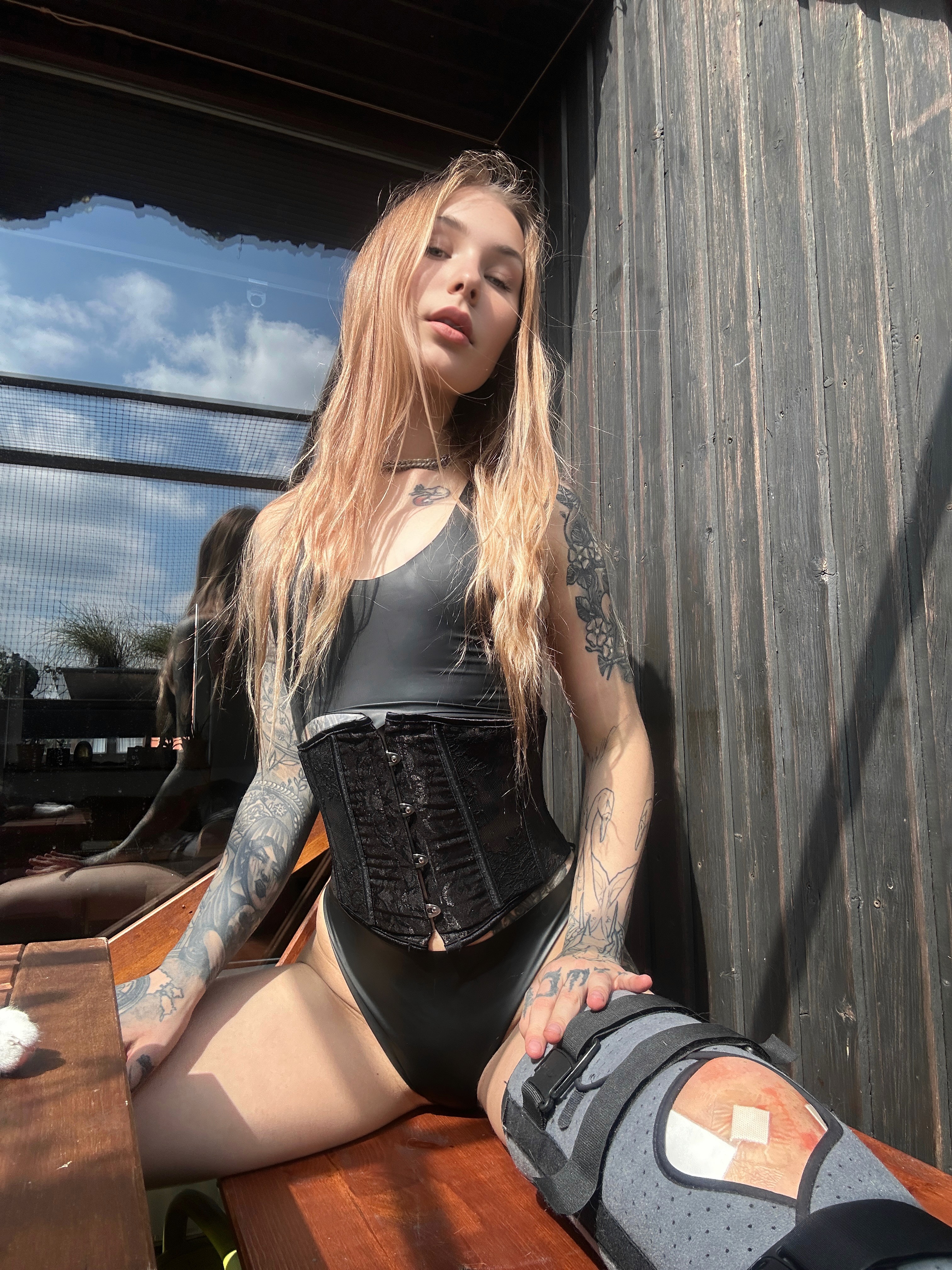
Absolutely. So first of all, I've been struggling with this [knee] injury for about three or four years. With performers it is quite often that you have an injury because you push yourself so absolutely to the maximum that something breaks. You are the only one who is accountable for all of your earnings, your social media presentation, everything, and you have to be constantly on stage and visible. So the injury actually started a long time ago. And then there was the process of going to different doctors constantly — nonstop. They couldn't figure out what was wrong so I still kept working, moving. It was a really hard couple of years before actually figuring out what was wrong and constantly pushing myself through the pain. It affects you mentally so much. Especially when it comes to legs because you are constantly using them. And it came to the point that, as a dancer, okay — maybe you could see me on stage doing different tricks and stuff. But when I came home, simply walking, standing, going up and down the stairs was nearly impossible. So… just a second, I have to breathe.
(Eliise pauses.)
Absolutely. So first of all, I've been struggling with this [knee] injury for about three or four years. With performers it is quite often that you have an injury because you push yourself so absolutely to the maximum that something breaks. You are the only one who is accountable for all of your earnings, your social media presentation, everything, and you have to be constantly on stage and visible. So the injury actually started a long time ago. And then there was the process of going to different doctors constantly — nonstop. They couldn't figure out what was wrong so I still kept working, moving. It was a really hard couple of years before actually figuring out what was wrong and constantly pushing myself through the pain. It affects you mentally so much. Especially when it comes to legs because you are constantly using them. And it came to the point that, as a dancer, okay — maybe you could see me on stage doing different tricks and stuff. But when I came home, simply walking, standing, going up and down the stairs was nearly impossible. So… just a second, I have to breathe. (Eliise pauses)
Absolutely. So first of all, I've been struggling with this [knee] injury for about three or four years. With performers it is quite often that you have an injury because you push yourself so absolutely to the maximum that something breaks. You are the only one who is accountable for all of your earnings, your social media presentation, everything, and you have to be constantly on stage and visible. So the injury actually started a long time ago. And then there was the process of going to different doctors constantly — nonstop. They couldn't figure out what was wrong so I still kept working, moving. It was a really hard couple of years before actually figuring out what was wrong and constantly pushing myself through the pain. It affects you mentally so much. Especially when it comes to legs because you are constantly using them. And it came to the point that, as a dancer, okay — maybe you could see me on stage doing different tricks and stuff. But when I came home, simply walking, standing, going up and down the stairs was nearly impossible. So… just a second, I have to breathe. (Eliise pauses)


Yeah, this is a bit of an emotional topic for me. Finally, last year, I figured out with new doctors what was happening with my body. And then came the process of actually confirming how big the damage is. After my first surgery, I lost most of my mobility. I really couldn't stand, I couldn't do anything. I really thought that I'm never going to dance again. Never going to do anything that makes me “me”. So going through that was like torture, really. Movement was my core, my identity. Losing that… it’s hard. You feel like you’ve lost everything. You start doubting everything — your confidence, your sense of hope. But at some point, you just have to understand for yourself that you need to make a change. I think that applies to many situations in life. Of course you have the right to be sad, feel like you have lost everything, and then have this grieving process. But you have to decide, okay, I'm going to start pushing to get out of that as much as I can. So for me, it was constantly training, training, training — just to see the progress. To have the motivation that, okay, actually, I want to dance again! I want to have my movement and my body back! Soooo, gotta put in the work. Even though there are days when you really cry, when you don't want to do it — it's painful, it's nasty — you have to have it in your mindset, in order to improve, you have to push. You have an obligation to yourself. Because for me, dancing is my everything. It really is. If I would have given up, I think this would have also been a sign that maybe this profession actually isn't for me.
Yeah, this is a bit of an emotional topic for me. Finally, last year, I figured out with new doctors what was happening with my body. And then came the process of actually confirming how big the damage is. After my first surgery, I lost most of my mobility. I really couldn't stand, I couldn't do anything. I really thought that I'm never going to dance again. Never going to do anything that makes me “me”. So going through that was like torture, really. Movement was my core, my identity. Losing that… it’s hard. You feel like you’ve lost everything. You start doubting everything — your confidence, your sense of hope. But at some point, you just have to understand for yourself that you need to make a change. I think that applies to many situations in life. Of course you have the right to be sad, feel like you have lost everything, and then have this grieving process. But you have to decide, okay, I'm going to start pushing to get out of that as much as I can. So for me, it was constantly training, training, training — just to see the progress. To have the motivation that, okay, actually, I want to dance again! I want to have my movement and my body back! Soooo, gotta put in the work. Even though there are days when you really cry, when you don't want to do it — it's painful, it's nasty — you have to have it in your mindset, in order to improve, you have to push. You have an obligation to yourself. Because for me, dancing is my everything. It really is. If I would have given up, I think this would have also been a sign that maybe this profession actually isn't for me.

You've been creating your own costumes and customising heels. Is that somehow connected to your injury?
You've been creating your own costumes and customising heels. Is that somehow connected to your injury?
Initially, there wasn't any connection to my injury. You can't predict something like that happening, so customising my things was more visual — how I wanted to present myself. Heels were always something that I really invested in and paid attention to, because everything else was rather on the cheaper side. I don’t wear expensive jewellery, so I don't mind if it breaks. It’s mostly just so the visual is there. But with heels, I customised them a lot more, and I'm a lot more careful with them. I love the aesthetic of just having high heels. And having something special that doesn’t overlap with the other girls in the club was something I found interesting for myself. Now, I have to say that wearing high heels was a big part of what caused my injury. But this was something I found out a lot later, after my injury had already happened — that this was the thing that affected my knee so much. So this brings me to the point that I have a big new project coming up.
Initially, there wasn't any connection to my injury. You can't predict something like that happening, so customising my things was more visual — how I wanted to present myself. Heels were always something that I really invested in and paid attention to, because everything else was rather on the cheaper side. I don’t wear expensive jewellery, so I don't mind if it breaks. It’s mostly just so the visual is there. But with heels, I customised them a lot more, and I'm a lot more careful with them. I love the aesthetic of just having high heels. And having something special that doesn’t overlap with the other girls in the club was something I found interesting for myself. Now, I have to say that wearing high heels was a big part of what caused my injury. But this was something I found out a lot later, after my injury had already happened — that this was the thing that affected my knee so much. So this brings me to the point that I have a big new project coming up.
Yeah, I'd love to know more — without revealing too much.
Yeah, I'd love to know more — without revealing too much.
I can’t talk too much about it, but I want to combine my long experience of wearing high heels with the aim of minimising the impact on the body. Or at least make it a bit more comfortable, a bit more caring for your body but still keep the aesthetic. So yeah, I have a project coming up related to that, and I’m still in talks with production and designers. I hope it will help a lot of dancers not to be in the same situation as I was.
I can’t talk too much about it, but I want to combine my long experience of wearing high heels with the aim of minimising the impact on the body. Or at least make it a bit more comfortable, a bit more caring for your body but still keep the aesthetic. So yeah, I have a project coming up related to that, and I’m still in talks with production and designers. I hope it will help a lot of dancers not to be in the same situation as I was.

Your project sounds super interesting and I love that through your experience you’ll be able to give something back.
Your project sounds super interesting and I love that through your experience you’ll be able to give something back.
Yeah, exactly. I really hope so. Of course, it depends — whether the project is going to be a success or not. But my intention is to help dancers both currently in the industry and those who will enter in the future.
Yeah, exactly. I really hope so. Of course, it depends — whether the project is going to be a success or not. But my intention is to help dancers both currently in the industry and those who will enter in the future.
You have a parallel career in IT, coding, and software development. How do you carry two such different worlds at once?
You have a parallel career in IT, coding, and software development. How do you carry two such different worlds at once?
This is something that really interests me. So half of me — actually, a bit more than half — is driven by this creative mind. And then the rest is very analytical, very business orientated. I like numbers and statistics, and this is also why I initially had an interest in coding. I started this about one year before dancing. I went to school to obtain the certification so I could say this was my profession. I never finished that. So before finishing with my IT career — or at least getting the qualification — I started dancing. And then I went back to IT. It started with going back and forth, trying to balance the two. But ultimately, I found a way to do them in parallel. So I can’t do my creative job full time. I need days in between where I’m actually living a normal life as well — having a more mundane routine and doing something more analytical that requires different parts of my brain to function.
This is something that really interests me. So half of me — actually, a bit more than half — is driven by this creative mind. And then the rest is very analytical, very business orientated. I like numbers and statistics, and this is also why I initially had an interest in coding. I started this about one year before dancing. I went to school to obtain the certification so I could say this was my profession. I never finished that. So before finishing with my IT career — or at least getting the qualification — I started dancing. And then I went back to IT. It started with going back and forth, trying to balance the two. But ultimately, I found a way to do them in parallel. So I can’t do my creative job full time. I need days in between where I’m actually living a normal life as well — having a more mundane routine and doing something more analytical that requires different parts of my brain to function.

What does switching between those worlds do to your mindset?
What does switching between those worlds do to your mindset?
It just helps me see things a bit differently. When I'm doing coding — or, for example, when I was last working as a business manager — I see things in a more business-orientated way, and this benefits a lot my artistic side, and vice versa. Because with my artistic side, it helps with finding creative solutions to things. There’s a fine line between keeping them separate and letting them inform each other, but you have to make it work both ways.
It just helps me see things a bit differently. When I'm doing coding — or, for example, when I was last working as a business manager — I see things in a more business-orientated way, and this benefits a lot my artistic side, and vice versa. Because with my artistic side, it helps with finding creative solutions to things. There’s a fine line between keeping them separate and letting them inform each other, but you have to make it work both ways.
You’re working on your pole dance teacher certification. What do you hope to give dancers that you didn't have early on?
You’re working on your pole dance teacher certification. What do you hope to give dancers that you didn't have early on?
I want to give them a safe space with everything — whether it is questions about different industries or even asking things that might sound stupid, but still feeling comfortable enough to ask them. For example, I had some really great teachers, but I think they lacked the experience of actually being inside the industry other than just pole sport. I hope to bring to the dancers who come to me to learn this safety net — that there is no stupid questions about stripping, about how to manage income, or about how to interact with customers. I really think it is important to appreciate that side as well and offer this to the students.
I want to give them a safe space with everything — whether it is questions about different industries or even asking things that might sound stupid, but still feeling comfortable enough to ask them. For example, I had some really great teachers, but I think they lacked the experience of actually being inside the industry other than just pole sport. I hope to bring to the dancers who come to me to learn this safety net — that there is no stupid questions about stripping, about how to manage income, or about how to interact with customers. I really think it is important to appreciate that side as well and offer this to the students.
So it’s about more than teaching people how to dance—it’s offering a more holistic approach?
So it’s about more than teaching people how to dance—it’s offering a more holistic approach?
Yeah, exactly. So of course, the main focus will be on teaching how to dance. But I want them to feel comfortable and confident, knowing that the teacher also has experience in different industries — so they know they can come to me with questions they might not be able to ask somewhere else.
Yeah, exactly. So of course, the main focus will be on teaching how to dance. But I want them to feel comfortable and confident, knowing that the teacher also has experience in different industries — so they know they can come to me with questions they might not be able to ask somewhere else.
Do you think this kind of approach to teaching pole dancing is lacking, or do you feel it already exists within the industry?
Do you think this kind of approach to teaching pole dancing is lacking, or do you feel it already exists within the industry?
It does exist to some extent but I personally haven’t had a teacher like that yet. Even if you’re looking for resources or thinking about entering the industry and don’t know who to ask, it is important to have a person or a community you can turn to.
It does exist to some extent but I personally haven’t had a teacher like that yet. Even if you’re looking for resources or thinking about entering the industry and don’t know who to ask, it is important to have a person or a community you can turn to.

photo Arjun Poonthoppil Ajith
photo Arjun Poonthoppil Ajith
photo Arjun Poonthoppil Ajith
If the audience could remember only one invisible truth about your creativity, what would it be?
If the audience could remember only one invisible truth about your creativity, what would it be?
It would be that everything actually happens behind closed doors. Everything happens before you see the performer on stage. You really never know how many years, or how much effort, a person has put into it — but if it looks effortless, there is immense work behind it. The preparation is insane.
It would be that everything actually happens behind closed doors. Everything happens before you see the performer on stage. You really never know how many years, or how much effort, a person has put into it — but if it looks effortless, there is immense work behind it. The preparation is insane.
Is there anything you would like to add to the conversation in closing?
Is there anything you would like to add to the conversation in closing?
I think it is really important to put it out there that, since I am — and have been — in the sex industry for quite a long time, people understand that there are so many different branches of it. You can have performance artists, dominas, strippers, content creators, full-service girls, companionships, etc. This world is so wide, and I really, really hope that people eventually start valuing it more as an actual job. It simply doesn’t get enough recognition — even when it comes to things like pole dance, performances, and training. I have witnessed how people feel a kind of shame of where it originates from, and I think that should be different. MEGABUFF
I think it is really important to put it out there that, since I am — and have been — in the sex industry for quite a long time, people understand that there are so many different branches of it. You can have performance artists, dominas, strippers, content creators, full-service girls, companionships, etc. This world is so wide, and I really, really hope that people eventually start valuing it more as an actual job. It simply doesn’t get enough recognition — even when it comes to things like pole dance, performances, and training. I have witnessed how people feel a kind of shame of where it originates from, and I think that should be different. MEGABUFF